
Aim of the patient information
This patient information is for patients having a DPD scan. It aims to tell you what a DPD scan is and what will happen.
General information
A doctor has asked that we take some pictures of your body, particularly your heart. The pictures will show if there is a build-up of abnormal protein (amyloid) inside your heart and how well blood is being pumped around your body.
As the test involves small amounts of radiation, we ask that you are not accompanied by children under 18 or anyone who may be pregnant. You may bring one adult with you to the department.
If the appointment clashes with another outpatient appointment or test, or you are unable to attend on this day, please contact the Nuclear Medicine department on the number provided as soon as possible. We can then reschedule the test and assign the appointment to another patient.
If you have mobility issues, are incontinent or claustrophobic please contact the department on the number provided.
Benefit and risks of the test
Everyone receives some radiation every day from the radioactivity in the air, food we eat and even from space. The amount of radiation for this test is similar to your natural exposure over two and a half years, so the risks associated with it are low.
The main benefit of the test is making the correct diagnosis, so you can get the treatment that is right for you. This benefit is far greater than the small risk from radiation.
If you have any concerns, please contact the department in advance or ask to speak to someone on the day of your scan.
Preparation
If you are pregnant or breast-feeding, you must inform the department as soon as possible as special arrangements may have to be made.
On the day of your appointment, please bring with you a list of all medication that you are taking (your repeat prescription sheet if possible).
There is no special preparation required for this test. Please eat and drink as normal both before and throughout the test.
What does the test involve?
There are two parts to this test.
Part 1
The test involves giving an injection of a radioactive tracer into one of your veins in either your hands or arms. There should be no ill effects from the injection and once given, you are free to leave the department for approximately 3 hours. This gives the injection time to circulate. Alternatively, you are welcome to stay in or around the department if this would be more convenient.
Part 2
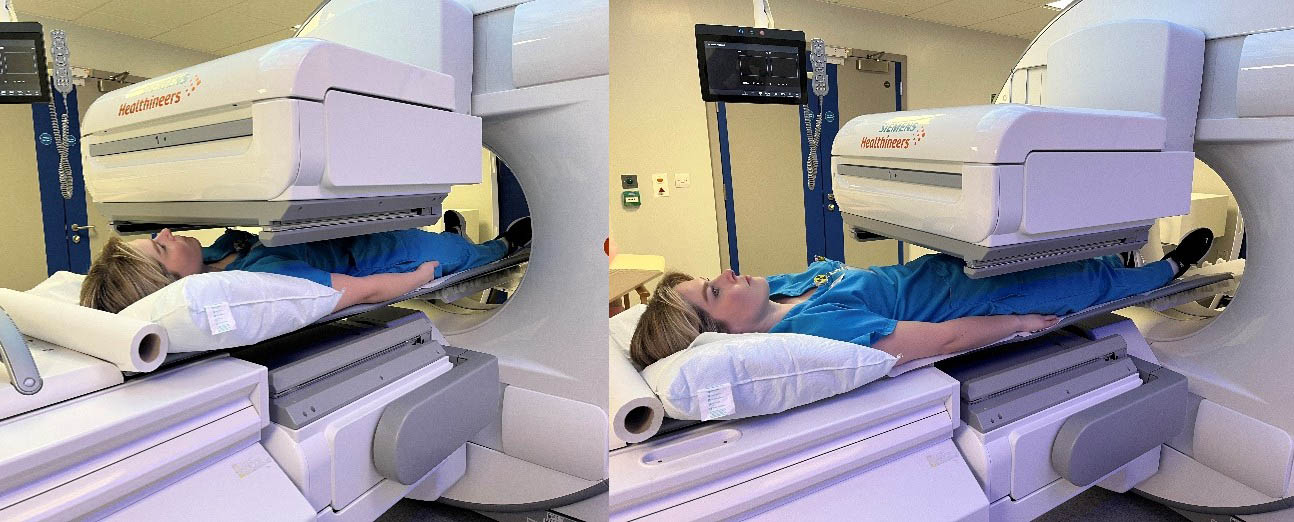
At 3 hours post injection, you will be asked to lie flat on a bed whilst a Gamma Camera takes pictures (see photos below). The pictures normally take 20 to 30 minutes. The camera will then be positioned to move around you and take pictures of your heart. We may use a CT attached to the camera to give us more information. The pictures take about 10 minutes.
The pictures will be checked before you are allowed to leave the department. Some patients need additional pictures. You will then be free to leave the department.
Your examination should take approximately 4 hours in total.
After the test
For the rest of the day, you must take extra care to wash your hands thoroughly after toilet use, sit down when you use the toilet and to flush the toilet twice. You must also continue to drink extra fluids (unless you have been given fluid restrictions by your doctor) and empty your bladder frequently. This will improve the clearance of the radiation from your body.
When the test is completed, the images will be reviewed, and a report will be available to the doctor who has requested the test.
The Camera
The Gamma camera used to take the pictures has an open design and the majority of patients complete the test without any discomfort.
Radiation information
If you would like to find out more about medical radiation, please access the following link:
https://www.gov.uk/government/collections/medical-radiation-uses-dose-measurements-and-safety-advice