
What is a hysteroscopy?
A hysteroscopy is a test used to look inside your womb. A thin tube with a small camera is used. The doctor gently passes it through the vagina into the womb. A small amount of salty water is used. This helps to see the inside of the womb clearly. The pictures are shown on a screen.
Why do I need a hysteroscopy?
A hysteroscopy helps find the cause of:
- Heavy periods
- Periods that do not come at the same time each month
- Bleeding between periods
- Bleeding after sex
- Bleeding after your periods have stopped (menopause)
- Bleeding while taking hormone treatment (HRT)
- Unusual vaginal discharge
- Possible growths in the womb (polyps or fibroids)
- Problems getting pregnant
These problems may be due to:
- A thin womb lining
- Growths in the womb (polyps) or womb wall (fibroid). In most cases, these are not cancer
- Heavy periods when your periods are stopping (menopause)
- In a very small number of cases, changes in the womb lining linked to early cancer or cancer
What may be done during the procedure?
During the test, the doctor may:
- Take a small sample from the womb lining (biopsy)
- Remove a small growth (polyp)
- Fit a hormonal coil (a small device placed in the womb)
- Plan further treatment if needed
Any samples taken are sent to the lab for testing.
Are there any risks?
All procedures have some risks. Most are small.
These include:
- Cramping or pain during or after the test (common)
- Infection (2 to 5 in 100 people). In rare cases, this can be serious
- Damage to the womb or cervix (about 1 in 1000 people)
- Heavy bleeding (about 1 in 400 people)
- Feeling dizzy (this settles on its own)
- Very rarely, needing to stay in hospital
What are the pain relief options offered?
The test is done while you are awake. This is the safest choice. It avoids risks from a general anaesthetic. It helps you recover faster. Most people feel some discomfort. 9 out of 10 people have little or no pain. 1 in 10 people have more pain.
Ways to reduce discomfort:
You can do a few things to help with pain:
- Take simple pain relief before the test
Take painkillers about 1 hour before.
You can take ibuprofen (400 mg) if this is safe for you.
You can also take paracetamol (1000 mg).
You can take both together if you are not allergic.
- Use gas and air (Entonox)
This is the same gas used in labour.
It helps to feel less pain. - Local anaesthetic
The doctor may use an injectable medicine to numb the cervix. This may be needed if the cervix needs to be opened. It can cause side effects such as: - a fast or strong heartbeat
- feeling sick
- shaking
- feeling warm or flushed
Your choices
You can ask the doctor or nurse to stop at any time. If you are worried about pain, talk to the team before the test. They will listen to your concerns and help plan your care.
Tell them if you:
- have had pain during vaginal examination or smear tests in the past
- tend to faint
- have had a bad experience before
- do not want the test while awake
Other choices
You may feel worried about having the test while awake. Speak to your doctor or nurse. You may be able to have the test with an anaesthetic. This means you will not feel the test.
This could be:
- a general anaesthetic. You are put to sleep
- a spinal anaesthetic. You are awake but the lower part of your body is numb.
You can choose not to have the test. This can make it harder to find the cause of your symptoms. It may also be harder to plan the right treatment.
Before the test:
- Eat and drink as normal before the test. This helps stop you feeling dizzy after.
- Take simple pain relief (see pain section).
- Bring a friend or family member. They can take you home after the test.
- Do not get pregnant before the test. Use birth control before the test. Start from your last period until the day of the test.
- The fluid used can move eggs and sperm into the tubes. This can lead to a pregnancy in the wrong place (ectopic pregnancy). This can happen before a pregnancy test shows positive.
- You may be asked to give a urine sample when you arrive.
- It may be hard to see inside the womb when you have your periods. The test may need to be done another day. Your GP may give tablets to delay your period or reduce bleeding.
During the test:
The test involves checking inside your vagina. Most people manage the test well. Some may find this type of test difficult. This is more common if you feel anxious. It can also happen if you have had a difficult past experience.
Tell your doctor or nurse if you feel worried or upset. You can do this at any time.
If talking is hard, you can write it down. The team is there to support you. They can offer other choices and help. You can ask them to stop at any time. You have another staff member with you (chaperone). You can also bring a friend or family member to support you.
- You will lie on your back. Your legs will be supported.
- A small tool (speculum) may be used to gently open the vagina. This is like a smear test.
- The cervix may need to be opened slightly. A numbing medicine may be used if needed.
- A thin tube with a camera is used as seen in diagram 1. It goes through the vagina and into the womb. The camera shows pictures on a screen. Salty water is used to open the womb. This helps the doctor see inside clearly. The test takes about 5 minutes.
- Sometimes treatment is done at the same time. This is called a “see and treat” clinic. A small growth (polyp) can be removed straight away. We use a small tool that passes through the camera to do this. This may take 10 to 15 minutes. Larger growths (fibroids) may need treatment another day. This may be done with anaesthetic.
- You may feel cramps like period pain. You may also feel mild pain or dizziness. These feelings settle quickly.
- You can use gas and air to help with pain.
- A small sample may be taken from the womb lining. This is sent to the lab for testing.
You can ask the doctor or nurse to stop at any time.
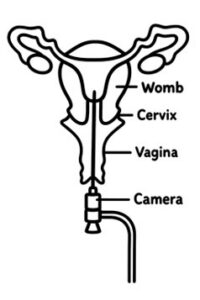
After the test:
- You may feel pain like period pain for a few hours. Take pain relief if needed. You can go back to your normal routine. This includes work, lifting, and exercise. Do this when you feel ready.
- If you use gas and air (Entonox), it wears off quickly. Wait at least 30 minutes before driving or using machines.
- You may have light bleeding for a few days. Use a pad or panty liner. Do not use tampons.
- Do not have sex for 14 days. Wait until bleeding or discharge has stopped.
- Do not go swimming during this time.
When to seek help?
Contact your GP if you have:
- a high fever
- pain that does not get better with pain relief
- discharge that smells unpleasant
- heavy bleeding
If you feel very unwell, contact your GP or NHS 111. You can also go to the hospital.
If the test is not successful
The doctor or nurse will talk to you. They will explain the next steps.
Getting your results
The doctor or nurse will tell you what they saw. If a sample was taken, it will be tested. You and your GP will get the results:
- within 3 weeks if cancer needs to be ruled out
- within 4 to 6 weeks for other results
Time off work?
Take off from work on the day of the test. Most people do not need more time off.
If you cannot attend?
Please try to come to your appointment. If you cannot attend, tell the hospital as soon as possible. We can give your slot to someone else. We will arrange another appointment for you.
Video link:
You can watch a short video about this test. Use the link below or scan the QR code.
https://vimeo.com/1047097321/d53099fcec?share=copy
Contact details for the hysteroscopy unit:
Lincoln (Hemswell Ward reception) – telephone: 01522 307937
(Monday to Friday 9.00am to 5.00pm)
Pilgrim – telephone: 01205 445432 (Monday to Friday 9.00am to 5.00pm)
Grantham – telephone: 01476 464401 (Monday to Friday 9.00am to 5.00pm)