
This is when we showcase our reserve forces. Reservists give up their time to serve in the reserve forces, balancing their civilian life with a military career to ensure that if their country requires them, they would be ready to serve.
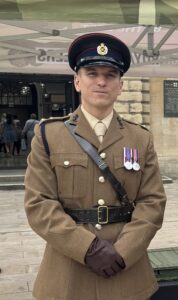
Douglas works for Lincolnshire Community and Hospitals NHS Group (LCHG) in the Community Physiotherapy team as a specialist. His role requires assessment, diagnosis and treatment of a variety of musculoskeletal conditions. Douglas provides exercise, treatment, and gives advice to patients on their conditions. Douglas is also deputy chair of LCHG’s Armed Forces Community Network, which is a group for NHS staff involved in the armed forces. The network organises events relating to the armed forces community, foster relationships with local military organisations and promotes NHS careers to those leaving the military, as well as working to support colleagues who belong to the armed forces community. Aside from Douglas’s role in the NHS, he also works for the Royal Engineer Army Reserves.
Douglas joined the reserves as a sapper which is the equivalent in rank to a private. He completed basic training at Prince William of Gloucester Barracks and then undertook combat engineer training. The main role of a combat engineer is to reduce enemy manoeuvrability on the battlefield whilst improving that of friendly forces for example bridge building and demolitions.
Alongside studying for a master’s degree in physiotherapy and progressing to his current role as a specialist musculoskeletal physiotherapist, Douglas remained in the Royal Engineers. He is now an established troop commander responsible for the career management, mentorship, and support of soldiers.
Douglas said: “I find both my reserve role and my job as a physio most rewarding when I’m able to have a positive impact on someone’s life whether it be running soldiers through a woodblock and over hills in training or helping someone to rehabilitate an injured knee. And yes, there is often a crossover in these roles.
“Sometimes it can be difficult to combine both roles into one life and you find yourself wishing for more hours in the day! However, I am very lucky to have the support, belief and flexibility from the teams around me.
“Both my roles are immensely meaningful to me and I’m very proud to serve our armed forces and the NHS.”